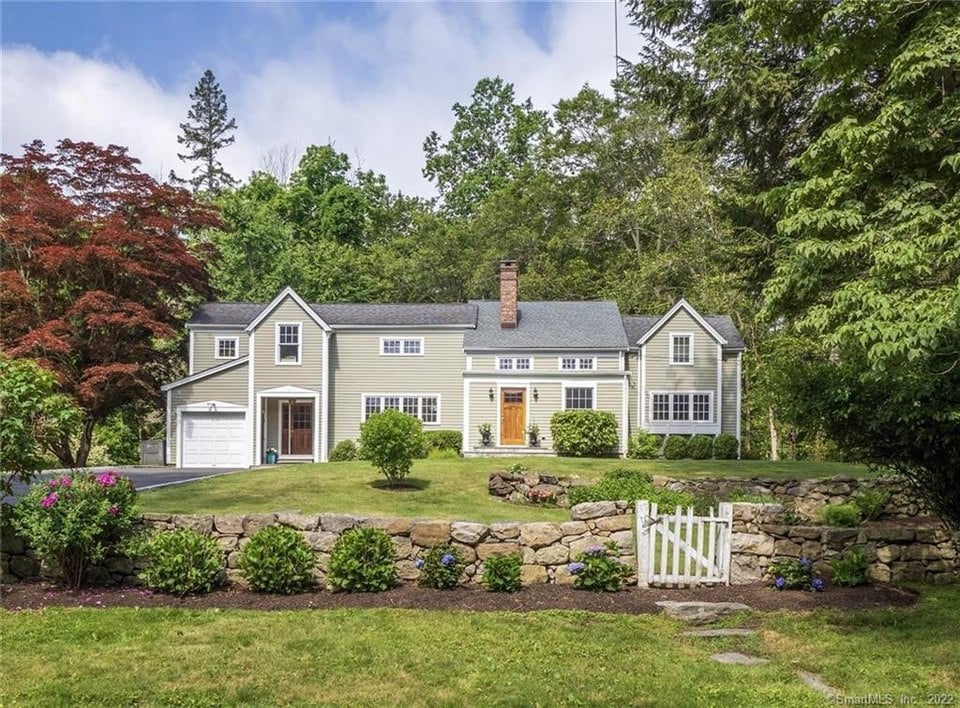
Thinking About Adding On to Your Farmington Valley Home?
Adam Cannon September 2, 2026
Adam Cannon September 2, 2026
You love your neighborhood. You like your yard. Your commute works. You don't particularly want to move.
You just need more space.
For homeowners throughout Farmington, Avon, Simsbury, Canton, and Granby, that can lead to an obvious question: Should we add onto the house instead?
An addition can absolutely make sense, particularly when you already own a home and location you love. But before meeting with an architect or contractor, it's worth figuring out whether the project works from three different perspectives: the property, the budget, and your longer-term plans.
In the Farmington Valley, the answer can be especially property specific.
Before deciding you need an addition, define the problem you're trying to solve.
Do you need another bedroom?
A larger kitchen?
A first floor primary suite?
A dedicated home office?
More living space?
Another bathroom?
A mudroom?
A garage?
Sometimes homeowners begin with "we need an addition" when the real issue may be solvable within the existing footprint.
An unfinished basement, oversized bedroom, underused formal dining room, attic, or existing floor plan may provide options that cost considerably less than expanding the house.
Other times, there's simply nowhere else for the space to come from.
Knowing exactly what you need makes it easier to evaluate whether adding on is actually the right solution.
A large lot can make an addition look simple.
There's plenty of room, so why wouldn't you be able to build there?
Because the physical size of the yard is only one part of the equation.
Local zoning requirements, setbacks, wetlands, easements, lot coverage, and other property restrictions may affect where and how you can expand a home.
Those considerations can vary by town and by property.
Before assuming a particular addition is possible, homeowners should review the applicable municipal requirements and have the proposed project evaluated by the appropriate professionals.
This is particularly important if the addition is essential to your decision to stay in the house.
Some Farmington Valley properties rely on private septic systems rather than public sewer.
That matters when you're planning certain improvements.
The Farmington Valley Health District oversees subsurface sewage disposal systems within its member towns, including Avon, Canton, Farmington, Granby, and Simsbury.
If a homeowner is planning an addition, accessory structure, swimming pool, or an increase in the number of bedrooms, the Health District requires appropriate review and permitting related to the septic system.
Why would an addition affect septic?
Because the property needs to be capable of supporting the home's sewage disposal requirements, including adequate space for the existing system and potential future replacement.
The Health District notes that before certain additions or renovations can be approved, a suitable area for repairing or expanding the septic system must be demonstrated. Soil testing may also be required depending on the property and proposed project.
That's something worth investigating early, not after you've already paid to design the addition.
Private wells are another property feature homeowners may encounter in parts of the Farmington Valley.
If your home has one, understand where it's located in relation to the project and how your plans may interact with applicable requirements.
Farmington, for example, directs homeowners with private wells and septic systems to the Farmington Valley Health District, which regulates these systems and maintains records for many existing properties.
This doesn't mean a home with a well or septic system can't be expanded.
It means those systems need to be part of the planning process.
Even if an addition is completely feasible, that doesn't automatically mean it's the best financial decision.
Start looking at the entire project.
Construction is only part of the potential cost.
Depending on the scope, there may also be architectural or engineering work, permits, site work, electrical, plumbing, HVAC changes, foundation work, roofing, exterior finishes, interior finishes, landscaping repairs, and unexpected expenses once construction begins.
If you're adding a kitchen, bathroom, or primary suite, costs can climb even further because of the amount of plumbing, electrical, cabinetry, fixtures, and finish work involved.
Build in room for the project to cost more than the first number you hear.
Not necessarily.
This is one of the most important distinctions homeowners should understand.
If you spend $150,000 adding onto your home, you shouldn't automatically assume the house is now worth $150,000 more.
Real estate value is determined by the market.
The finished size and functionality of the home may absolutely increase its value, but the surrounding comparable sales still matter.
This is where looking at renovated and expanded homes in your specific Farmington Valley town can be useful.
What are larger homes nearby selling for?
What would your property likely be worth today?
What might its value look like with the additional square footage and improvements?
Would the project make your home more consistent with surrounding properties, or would you be creating one of the most expensive homes in the immediate area?
You don't need every renovation to generate a dollar for dollar return. If you plan to stay for another 15 years and the addition dramatically improves your life, personal value matters too.
You should simply know which type of investment you're making.
This is the step homeowners sometimes skip.
Before committing to a major addition, find out what it would cost to buy the house you're trying to create.
Suppose you own a three bedroom home and are considering a substantial project to add another bedroom, bathroom, and larger living area.
What would a four bedroom home with those features cost in your preferred area of Farmington, Avon, Simsbury, Canton, or Granby?
The answer may reinforce your decision to renovate.
Or it may surprise you.
If completing the addition would require a major financial investment, months of construction, and compromises elsewhere on the property, moving may deserve consideration.
On the other hand, if homes with the space you need are considerably more expensive or rarely become available in the location you love, improving your current property may make much more sense.
This decision isn't purely mathematical.
Maybe your children love the neighborhood.
Maybe you have a property that would be difficult to replace.
Maybe you're close to family.
Maybe your commute is perfect.
Maybe you've spent years improving the yard.
Or maybe you've realized that the house isn't the only problem.
Perhaps you'd also like a different location, less property maintenance, more land, a shorter commute, or a completely different type of home.
An addition can solve a space problem.
It can't solve a location problem.
Be clear about which one you actually have.
There's also a practical side to renovating that homeowners shouldn't underestimate.
A substantial addition can mean months of contractors, noise, dust, disrupted routines, and portions of the house being difficult or impossible to use normally.
Depending on the project, you may even need temporary accommodations during certain stages.
Some homeowners are completely comfortable with that.
Others reach the planning stage and realize they'd much rather pack once and move.
Neither answer is wrong. But the disruption deserves to be part of the decision alongside the financial numbers.
Before spending significant money designing an addition, it can be helpful to understand two numbers:
What could your Farmington Valley home sell for today?
And:
What would it cost to buy a home that already gives you what you're trying to build?
Those numbers give you a much better foundation for deciding whether to renovate or move.
You may find that adding onto your existing home is clearly the best choice.
You may discover that selling and buying something larger is financially closer than you expected.
Or you may decide that neither needs to happen immediately.
The point isn't to push the decision in either direction. It's to know your options before committing to an expensive project.
If you're considering an addition because your current Farmington Valley home no longer gives you enough space, I can help you understand its current market value and compare that with available homes and recent sales throughout Farmington, Avon, Simsbury, Canton, and Granby.
Sometimes the right next home is the one you're already living in.
And sometimes understanding what else is available makes the decision to move much easier.
Adam Cannon, Realtor
Coldwell Banker Realty | West Hartford
Stay up to date on the latest real estate trends.
Whether buying, selling, or exploring your options, I am ready to help you achieve your goals. With experience, integrity, and commitment, I’m the partner you can count on for exceptional real estate results.